Browse the Catalogue
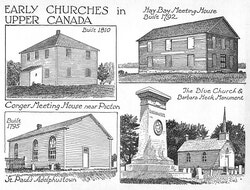
Conger Meeting House, 1810, St. Paul's Adolphustown, 1795, Hay Bay Meeting House, 1792
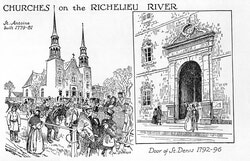
Most of the early Quebec churches existing today were built during the period from about 1770 to 1825.
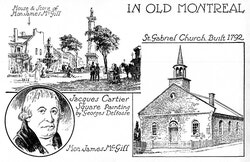
The corner stone of the Nelson monument was laid in 1809. Near it was the pillory where criminals were exposed with a label on their breasts stating the nature of their offence.
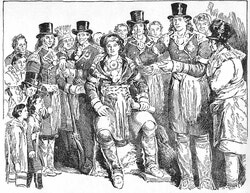
This picture is copied from a lithograph by H. Linch, after a painting by H. D. Thielcke. It shows the official or gala costume worn by Canadian Indian chiefs about 1796.
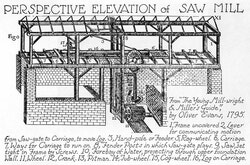
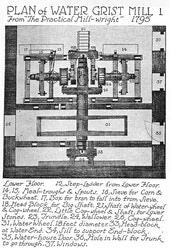
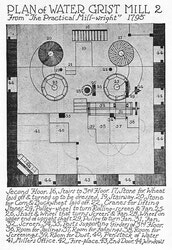
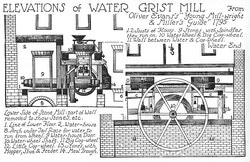
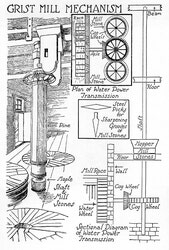
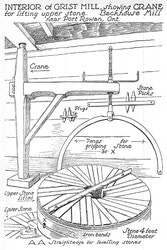
The beautifully carpentered crane resembles an engraving in Oliver Evans's Young Mill-wright's Guide, but is more elegant in design.
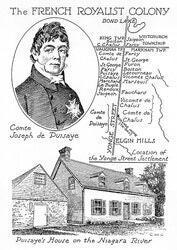
In 1797 Count Joseph de Puisaye, a refugee from the French Revolution, laid a plan before the British Government for the settlement of a number of French Royalist émigrés on lands to be granted to them in Canada.
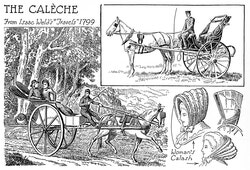
The Caléche was a two-wheeled vehicle in use in Lower Canada, similar to the one-hoss shay, or chaise of New England with the addition of a seat in front for the driver.
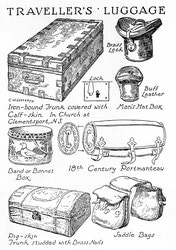
Calf-skin trunk, band box, pig-skin trunk, saddle bags, portmanteau, hat box, brass lock
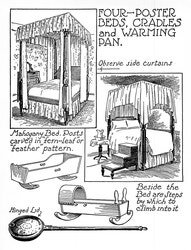
Bedsteads were furnished with a canopy, called a tester, and side curtains which could be drawn close to keep out draughts and night air, which was thought to be harmful to health.
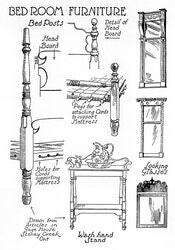
Much of the pioneer furniture was home-made, in spells of leisure on rainy days and in winter, or by a neighbouring carpenter.
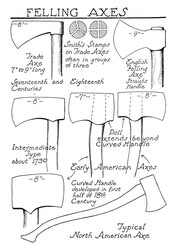
This page is planned to show the changes in the shape of the axe from the European tool of the first settlers on this continent to the typical North American axe of the nineteenth century.
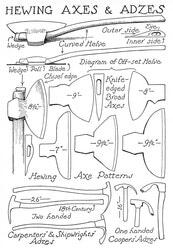
The Hewing Axe was used by lumbermen for squaring timbers for rafting and stowage in vessels, and by carpenters for smoothing beams, planks and rafters.
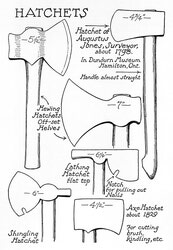
Hewing hatchets followed the shape of hewing axes, but, as indicated on the illustrations, they were of smaller dimensions.
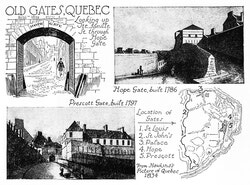
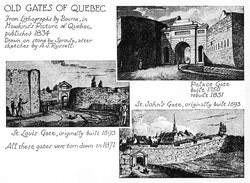
Looking up Ste. Famille St. through Hope Gate, Hope Gate, Prescott Gate, map showing location of gates, from Hawkins, Picture of Quebec , 1834,
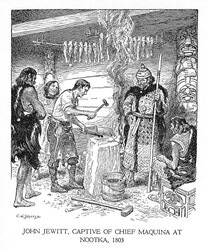
In March, 1803, the ship Boston, of Boston, Massachusetts, arrived in Nootka Sound, on the west coast of Vancouver Island, to trade with the Indians.